Andrew L. Urban
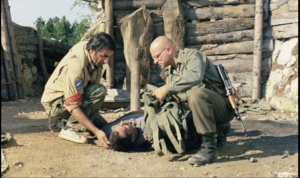
One morning in June 1993, Èiki (Branko Djuriæ), a Bosnian soldier, finds himself in a trench in the middle of no man’s land, after a skirmish with Serbs. Two Serb soldiers sent to check out the situation get trapped with him and his wounded buddy Cera (Filip Šovagoviæ). There is no way out without being shot. The Serbs booby trap the wounded Cera so he can’t move. When the younger Serb soldier, Nino (Rene Bitorajac), equalises the stand off with Èiki, he and his former neighbour – now on the opposing side – try to survive in the midst of an insane situation in a hideous war. Journalist Jane Livingstone (Katrin Cartlidge) triggers the involvement of UN peacekeepers led by a well-meaning but frustrated Sgt Marchand (Georges Siatidis) – to little avail. The UN squad achieves nothing and departs, leaving Cera lying on the device that will explode if he tries to move off it.
This is the gut-wrenching scenario in Danis Tanovic’s Oscar winning No Man’s Land (Best Foreign Language Film, 2002), touted as an anti-war film. I call it an anti-UN film. It demonstrates the uselessness of the UN as a global peacekeeping ‘police’ force. It is worse than useless, really, because it is expected to solve such issues, prevent them even. But doesn’t. Can’t. Won’t.
In its editorial of March 17, 2026, The Australian pinpoints in devastating fashion not just that the UN is a failure, but that it is counterproductive and anti-democracies … and that it is also virulently antisemitic.
Iran’s is a regime of tyranny with nuclear weapons ambitions. But as our correspondent, Shokoofeh Azar, reports, the murderous repression was notable not only for the scale of systematic state violence but also the lack of international response. The UN Human Rights Council did not establish a fact-finding mission or an independent commission of inquiry to investigate what had happened. The UN Security Council did not convene an emergency session or refer the case to the International Criminal Court. Instead, less than one month after the murderous crackdown, UN secretary-general Antonio Guterres issued a congratulatory message marking the anniversary of the Islamic Republic and a representative of the Islamic Republic was appointed vice-chairman of the Commission for Social Development.
With both Russia and China enjoying veto powers, historically seen as insurance, now just a black joke, the UN is as useful to the world as that ashtray on a motorbike. (Russia and China have veto powers at the UN because they are among the five permanent members of the United Nations Security Council, a status granted to them after World War II to ensure that major powers have a decisive role in maintaining international peace and security. Don’t laugh…)
I suggest there is a case for a new international organisation that is comprised of genuinely democratic sovereign states. (The current UN membership includes rogue states such as Afghanistan, Cuba, Iran, Nicaragua, North Korea, Sudan, Syria and Venezuela; I would add Russia and China.)
Such a new organisation, perhaps with the working title Peace International, would take an active role in policing the global stage, backed by its own substantial military capabilities. It would have, for example, intervened on the first day of Russia’s invasion of Ukraine. The UN couldn’t have done so, held back by a Russian veto. Guts and determination, a resolve to pursue its charter, would make a difference in the world.