
Andrew L. Urban
It is probably the worst possible time to publish another book arguing how a man was wrongfully convicted of historical sexual abuse of teenage girls. I am aware of this. FRANK VALENTINE GUILTY BY SAY SO As did my earlier book about Noel Greenaway (Presumption of Evil, 2024), challenging such a conviction flies in the face of popular public and media opinion, especially in the wake of peak #MeToo and the confronting mid-2025 revelations of extensive sexual abuse in some Australian child care facilities. But …
On the other hand, it may be exactly the right time… an acutely timely opportunity to expose the flip side of the story, where innocent men become collateral damage in society’s rush to blame and punish men, setting aside what were once the established protections of the law. The baying mob is no substitute for the rule of law. And a legal system bent out of shape, intent on convicting men rightly or wrongly, is just legalised vigilantism.
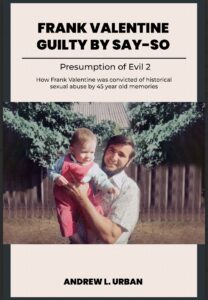 My new book, Frank Valentine – guilty by say-so, follows the road to what I see as the pre-determined outcome in a legal system which no longer requires corroboration of historical sexual abuse claims; the claimants’ say-so (decades later) is all the evidence needed. Such crimes have become crimen exceptum – crimes so exceptional that the established rules of justice need not be applied to them. Protestations of innocence, evidence of good character and exculpatory evidence are swept aside.
Valentine was 78 at his 2019 trial and in his 30s at the time of the sexual assault claims against him, between 1971 – 1974.
This is a book of long form journalism – my fifth exploring what I consider wrongful convictions and 11th in all – seeking and presenting evidence that challenges the convictions for which Valentine was sentenced to 22 years in prison.
When citizens believe the justice system can and does convict the innocent, the legitimacy of the system and by extension, of democratic governance, is weakened.
From the book: “Awoken by her phone ringing, Maris Valentine answered wearily, “Hello…” The caller was Detective Sergeant Tim Paul. He was standing outside her door, accompanied by two other police of Strike Force Bilvo and three Queensland police officers in full operational gear. None of the attending police officers even offered to wait for the Valentines to get dressed. There followed an unnecessarily heavy-handed search. The ten thousand or so residents of the beautiful Queensland seaside suburb of Redcliffe had never witnessed anything like it. The median age is 44. That is seven years older than the median age of the population of Australia, a suitable spot to retire in peace, thought the Valentines, in their 70s.”
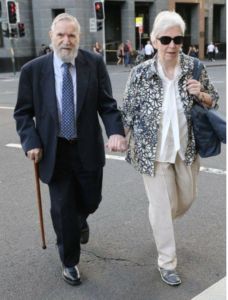
Frank & Maris outside court
“It is better that ten guilty persons escape than that one innocent suffer.” — Sir William Blackstone (18th-century English jurist).
This formulation captures a core democratic value: protecting the innocent is more fundamental to justice than maximizing convictions. Its erosion via wrongful convictions undermines confidence in fairness and the rule of law itself.