
I’ve always blamed the mass media for the damage done to energy policies around the world. Had they interrogated the earliest claims that mankind is causing warming, as closely as they interrogate fraudulent politicians, we would have been spared the past 30 years of socio-economic self harm. Growing up, we all learnt (or should have) about the comings and goings of ices ages and the variability of climate over four billion years. Even at times before naughty mankind started lighting fires.
So it is with a resigned sigh that I bring this story to our readers. It comes from a new book with a long title: The Frontier of Climate Science: Solar Variability, Natural Cycles and Model Uncertainty, by Nicola Scafetta. It is as illuminating as the sun, by an Italian research scientist at the University of Napoli Federico II. It reminds readers that science advances not through consensus, but through continuous questioning.
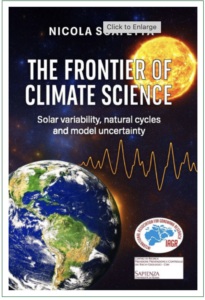 Hence he states that “My work on solar variability began more than two decades ago, partly through my involvement with NASA–JPL’s ACRIM experiment, which was designed to measure total solar irradiance from space. Over time, it became increasingly clear to me that the Sun’s influence on climate is significant, but that a proper assessment requires addressing the long‑standing controversies surrounding solar variability on timescales longer than the 11‑year solar cycle — controversies that remain central to understanding the natural contribution to modern climate change.”
And that’s partly because “Over the years, I have become increasingly convinced that the climate system cannot be fully understood through a single explanatory lens. The prevailing attribution framework is the one currently advocated by the Intergovernmental Panel on Climate Change (IPCC). It assigns nearly all post‑1850 warming to anthropogenic forcings. However, this assessment rests on computer global climate models (GCMs) that, while sophisticated, still struggle with fundamental aspects of natural variability.” That’s putting it mildly!
In her foreword to the book, climate scientist Judith Curry writes: “Solar variability and its role in climate change remain among the most profound and unresolved issues in climate science. Scafetta makes a compelling argument that it is time to bring the Sun back to the center of climate discourse.”
Indeed, Scafetta’s goal was “to bring these threads together into a coherent, interdisciplinary perspective — one that reflects not only the breadth of the scientific debate, but also the many dimensions of the problem that I have personally explored in my own scientific publications over the past two decades, from solar variability to climate oscillations, from data biases to empirical modeling.”
Scafetta is not suggesting that policies chasing net zero results be abandoned (more’s the pity) but that “net‑zero mitigation policies may ultimately not be necessary to meet the Paris Agreement target of keeping global temperatures below 2 °C by 2100, since this same target could also be achieved under the more moderate and affordable SSP2 pathway, which emphasizes adaptation combined with moderate mitigation.”
So Scafetti’s book is required reading for climate scientists and policy makers alike – although I doubt the latter will convert its information load into policy payload. Again, more’s the pity.
| An excerpt of the book with the contents, forewords, and introduction can be downloaded from here |
______________________________________________________________

The author investigates the circumstances that led to the trial and conviction of child welfare officer Frank Valentine on charges of historical sexual and physical abuse at the Parramatta Training School for Girls decades earlier. It is his fifth book exposing what he considers to be unsafe convictions.
Kindle $11.99 Paperback $23.20