Two teenagers, who were allegedly inspired by the Islamic State (IS) extremist group, have been charged with terrorism offences following an incident at an anti-Muslim protest in New York mid-March 2026. But at the other end of the A Train line, ANDREW L. URBAN steps into the serenity of a Medieval monastery.
It feels like entering another, past world as invisible monks chant ethereal Gregorian hymns (I know all the songs, I have the CD), and the 12th century stones, rough to the touch, seem to echo with the sound of stonemasons’ chisels, creating columns and figurines that now bathe in the sunshine of the 21st century.
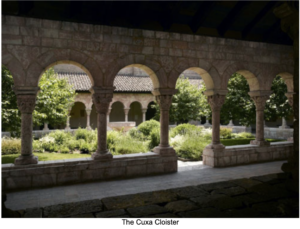
In its own time trapped world, The Cloisters will celebrating the 88th anniversary (in May 2026) of this most remarkable museum in Manhattan, up on Fort Tryon Park Hill at the end of the A train line, the one immortalised in Billy Strayhorn/Duke Ellington jazz standard, Take the A Train.
If going by bus, the route up Madison Avenue lurches through Harlem; it could be called New York’s “gee whiz” bus ride, grinding from glamour and Gucci, through the grotty, to the Gregorian. I like it; it’s part of the whole experience.
The 1.6 hectare setting is parkland, the outlook over the Hudson River expansive. The building itself was developed around architectural elements dating from the 12th to 15th centuries, and the millstone granite used on the exterior gives it the aura of an abbey.
“in a sympathetic and harmonious setting”
The Cloisters is the Metropolitan Museum of Art’s branch for medieval art where “medieval art of the finest quality and widest diversity can be enjoyed in a sympathetic and harmonious setting.” For just $30 dollars an adult, $22 for seniors, $17 for students.
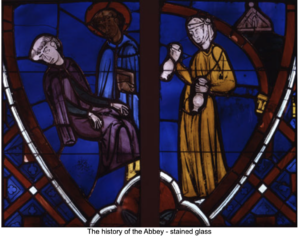
When it first opened in 1938, it was already a remarkable achievement, a self-contained world of medieval sculpture, stained glass and tapestries. Numerous Romanesque and Gothic elements have been incorporated functionally into the building and care was taken to arrange antique objects with relation to their original use. Perhaps most striking of all is the absence of extensive restoration of the works of art.
The millstone granite was cut by hand, its warm tones recalling the stone found in southern France. The principal interior stonework is Doria limestone, quarried near Genoa in Italy. Sand sawn and left without further tooling, it has the appearance of weathered stone.
Since its opening, the museum’s collection has grown with the addition of numerous works – the finest of their kind – including The Nine Heroes Tapestries, The Annunciation Altarpiece by Robert Campin, the Belle Heures of Jean, Duke of Berr and the fabulous English Ivory Cross, believed to be from the abbey of Bury Saint Edmunds.
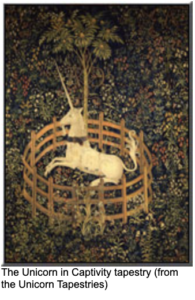
One of the great treasures of The Cloisters is the series of seven Hunt of the Unicorn tapestries, made at the end of the 15th century, and regarded as the artistic sisters of The Lady with the Unicorn series of six tapestries from the same era, now in the Cluny Museum in Paris. Enough similarities exist between the two series to suggest that one or more of the same artists were involved in the execution of both.
“It began on a bicycle at the turn of the century in France”
For all its treasures, The Cloisters was not the result of a conscious policy decision by The Met to create and curate a Medieval museum of sacred art. It began on a bicycle at the turn of the century in France.
George Grey Barnard, an American romantic and sculptor of some note living in France, began the collection that eventually led to the creation of The Cloisters. It was while he was living in a village near Fontainbleu that he noticed local farmers using fragments of medieval stonework from ruined churches to repair their homes and barns. He began buying good examples for a few francs to sell at considerable profit to dealers and collectors. Romantic he may have been, but stupid he was not.
In a barn near Dijon, he rescued the limestone relief of The Miracle of Saint Hubert and the Stag, now in the Cuxa Cloister walk: it had been used to help wall up a pigsty. On another farm, he discovered the exquisite 12th century wood torso from the Auvergne of the crucified Christ. It had been dressed up as a scarecrow. It now stands (without the scarecrow clothing) in The Romanesque Hall.
Travelling around on a bicycle, Barnard next began to assemble elements of several medieval cloisters: Saint Michel de Cuxa, Saint Guilhem le Desert, Bonefont en Comminges, Trie en Bigorre and Froville, which collectively make up The Cloisters, each forming a quadrangle enclosed by a vaulted passageway.
“cloister museum”
By the end of 1914 he had shipped his entire collection to New York and opened what he called his “cloister museum” on Fort Washington Avenue, just south of Fort Tryon Park. The reaction was enthusiastic and one of his most impressed visitors was John D. Rockefeller Jr, who not only purchased individual medieval pieces, but also bought some of his sculptures, including an Adam and Eve. Rockefeller became a serious patron.
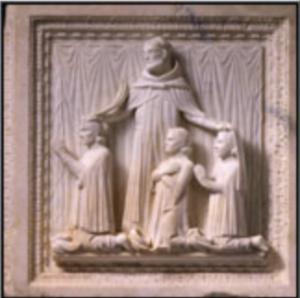 In 1925 Barnard offered his collection to the Metropolitan, and Rockefeller provided the funds for the purchase. It soon became obvious that the Fort Washington avenue site was inadequate and in 1930 Rockefeller gave his 56 acre Fort Tryon property to the city of New York, offered to pay for landscaping, and reserved four acres at the north for a new medieval museum building.
To his eternal chagrin, no doubt, Barnard died in 1938, just before the new museum was completed, also financed by Rockefeller. Rockefeller even bought 700 acres of land on the Palisades across the Hudson to protect the view from The Cloisters.
In the Treasury, which houses the smaller, but highly precious items, state of the art conservation techniques have been installed (as part of the 50th anniversary celebrations in 1988), which enable The Cloisters to exhibit the finest textiles from its collection, along with dozens of other, priceless pieces of art.
“meditation, conversation, simple enjoyment”
Then there are The Cloister Gardens, each of the four gardens serving the same primary purposes as they did when built for the monks in the Romanesque and Gothic periods: meditation, conversation, simple enjoyment.
The Cuxa garden, for example, with its crossed paths forming quadrants of rich green lawn, has four symmetrical perennial borders and its flowers have been chosen to ensure an effective display from spring to autumn – albeit some of the flowers were not found in medieval times, like bluebells, sweet alyssum and anemones. But the yellow blossomed cornelian cherry, delicate snowdrops, columbines, forget me nots, saffron and the ethereal white Madonna lily, are all authentic.
By contrast, the Gothic Bonnefont Cloister, from around 1300, is more austere, and its garden is filled with 250 species of herbs used in the Middle Ages. Rich in colour and above all fragrance, it overlooks the unspoilt view of the Palisades across the Hudson.
It’s hard to remember that just down the road is the Empire State Building, Broadway, Chinatown, not to mention Harlem … and a communist Muslim Mayor. So out of place …