Andrew L. Urban
You could have heard a hand grenade pin drop … Australia should be a multiracial, Judeo-Christian monoculture, not multicultural, Senator Pauline Hanson said in her June 17, 2026 speech at the National Press Club, planting her stake in the policy battle over immigration, adding a crucial layer to the debate; it’s not just how many but who can settle here. And she placed radical Islam at the bullseye of her target. In this context, monoculture means the exclusion of incompatible cultures and protecting Judeo-Christian culture.
“Unfortunately for Labor, the Coalition and reform advocates it may be too late,” writes Tom Dusevic, columnist in The Australian. “The migration caravan has moved on. The conversation has shifted to questioning culture and values, while narrowing the definition of who can come to work, study and settle here. That ultimately leads to pulling apart decades of non-discriminatory policy, sorting people by colour, creed and race. Are we ready for that?”
Good question. Hanson talked about deporting radical non-citizen Muslim preachers and applying relevant laws in full to those born here. Let’s see who finds this unacceptable and why.
Our February 25, 2026 submission to the Royal Commission began with the following statement:
“It is submitted that the current government has conspicuously demonised Israel since October 7, 2023, which provided the political permission for a national attitudinal environment that tolerated (if not encouraged) antisemitism almost as official policy. This submission suggests that it was in that context that historical antisemitic elements – from those openly hostile to those easily led – were increasingly emboldened, feeling encouraged. The Government effectively (perhaps unintentionally) provided the ‘security blanket’ for antisemitism.”
But let’s be frank, the Australian Muslim community itself has contributed to the malaise by its reluctance to do anything to reign in antisemitic chants, preachers, marches and violence. Our submission lists some of these events. This misplaced tolerance also gives the impression of permission, especially when surveys show it is actually more than permission. (See below)
The 2019 (that is four years before the October 7 massacre in Israel by Gazan Palestinians) “Islam in Australia” National Survey (n=1,034 Muslim Australian citizens and permanent residents) conducted online in September–October 2019 by Griffith University researchers (Halim Rane et al.), disseminated via Muslim community organisations and social media was instructive – and alarming. The sample was broadly representative on key demographics (gender, age, birthplace, etc.), though self-selected and only in English.
-9.5% identified as “Political Islamist” (“I am a committed Muslim who believes politics is part of Islam and advocates for an Islamic state based on shariah laws”). That 9.5% of the Muslim population today (about 100,000) means almost 10,000 Muslim here are politically aligned with Islam.
-3.3% identified as “Militant” (“I am a committed Muslim who believes an Islamic political order and shariah should be implemented by force if necessary”). These are the closest proxies to “extremist” orientations; the researchers described the militant group as a “smaller sub-group” with views that “could be considered extreme.” That means another 30,000 or more are militants.
A survey today may well result in higher figures, given the expansion of antisemitism since October 7. Hanson’s doctrine does not seem alarmist. Hers is not a lone ‘infidel’ voice.
Islam has given birth to monsters
In an open letter* to the Muslim world, French Muslim philosopher Abdennour Bidar writes that Islam has given birth to monsters and needs reform – from within. “Many believers have so internalized the culture of submission to tradition and to the ‘masters of religion’ (imams, muftis, sheikhs etc.) that they don’t understand us when we talk to them about spiritual freedom or personal choice vis-à-vis the ‘pillars’ of Islam. This is a ‘red line’ for them – so sacred to them that they dare not allow their own conscience to question it. And there are so many families in which this confusion between spirituality and servitude is implanted from such an early age, and in which spiritual education is so meager, that nothing concerning religion may be discussed.
“ … what I have described here – a tyrannical, dogmatic, literalist, formalistic, macho, conservative, and regressive religion – is too often the mainstream Islam, the everyday Islam, which suffers and causes suffering to too many consciences, the irrelevant Islam of the past, the Islam that is distorted by all those who manipulate it politically, the Islam that always ends up strangling the various Arab Springs and the voice of the young people who are demanding something else. So when will you finally bring about this revolution in society and conscience that will make spirituality rhyme with liberty?”
But while recognising his diagnosis, many within and without the Muslim world disagree with Abdennour Bidar that reform from within Islam is a realistic possibility, precisely because of the very elements he describes. Besides, the notion of liberty in this context is diametrically opposed to Islam.
power symbolism
In the age of postcolonialism, Muslims have become largely preoccupied with the attempt to remedy a collective feeling of powerlessness and a frustrating sense of political defeat, often by engaging in highly sensationalistic acts of power symbolism. These are not my words, but those of Khaled Abou El Fadl #, professor of Islamic Law, who adds, “It is not an exaggeration to say that Islam is now living through its proverbial dark ages.” He says “There is a profound vacuum in religious authority, where it is not clear who speaks for the religion and how.” Hamas would disagree, claiming leadership despite its status of a blood stained fringe element.
Instead of Islam being a moral vision given to humanity, says El Fadl, “it becomes constructed into the antithesis of the West. In the world constructed by puritan modes of thinking and their groups, there is no Islam; there is only opposition to the West. This type of Islam, which the puritan orientation offers, is akin to a perpetual state of emergency where expedience trumps principal and illegitimate means are consistently justified by invoking higher ends.”
El Fadl provides a powerful insight: “With the deconstruction of the traditional institutions of religious authority emerged organizations such as the Jihad, al-Qa’ida and the Taliban, who were influenced by the resistance paradigms of national liberation and anti-colonialist ideologies, but also who anchored themselves in a religious orientation that is distinctively puritan, supremacist and thoroughly opportunistic in nature.
“This theology is the by-product of the emergence and eventual primacy of a synchronistic orientation that unites Wahhabism and Salafism in modern Islam – what I call ‘Salafabism.’ The consistent characteristic of Salafabism is a supremacist puritanism that compensates for feelings of defeatism, disempowerment, and alienation with a distinct sense of self-righteous arrogance vis-a-vis the nondescript “other” – whether the “other” is the West, non-believers in general, or even Muslim women.”
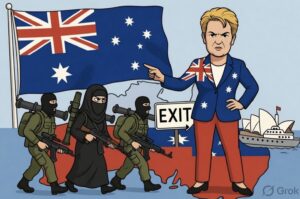 It is in this context that Hanson’s wish for a monocultural society makes sense. Some have been dismayed by the notion of monoculturism – mostly because they misunderstand what she means by it for Australia. She confirmed that it does not mean passing judgement on other cultures but managing multiracial Australia in a way that separates multiculturism from cosmopolitanism – the benign version on which Australia missed out since the 1970s when the points in the track were changed and we were set off on the wrong track, heading in the wrong direction. Cosmopolitan Australia provides all the moral and social benefits of an immigrant country without the destructive intrusion of violently anti Judeo-Christian warriors.
* This open letter was first published on October 3, 2014, in the French publication, Marianne, and re-published on November 5, 2014 as Special Dispatch No 5873 in The Middle East Media Research Institute (MEMRI)
A better term than monoculture, especially for several generation of migrants from different cultures would be COSMOPOLITAN , which recognises the underlying monoculure which forms modern Australia, even including Aborigines.