Andrew L. Urban.
This 28 minute YouTube video, What Hungary Just Did to Islamists Changes Everything (transcript below) is the most relevant, pertinent, important and informative history lesson that explains how and why the West is now paying the price for its tragically misguided immigration policies of the past dozen years. In 2015, Hungary’s newly erected razor wire-enforced southern border was called inhumane and cruel by the EU … until the other member states started to emulate it. But too late.
I was in Hungary for a few months in 2015 just when the Hungarian-Serbian border became the most contentious geopolitical site in the world as Viktor Orban single mindedly put up the barricades to stop the many thousands of illegal migrants – always kindly if misleadingly called asylum seekers – who were heading for the happy welfare fields of the continent. Benefit seekers? I heard and read the condemnations aimed at Hungary for its determined decision to disallow being overrun.
We didn’t know it at the time, but that was the moment that Europe lost its chance to do what Hungary did: insist on retaining its own culture, against the overwhelmingly Muslim illigrants, as I like to call them. Now look at us. Not only is Europe burning, the entire West is riven by the consequences of the foolish decision inspired by Angela Merkel’s welcome to the millions from the Middle East and North Africa, telling her nation “we can do this”.
Mass immigration, illegal, aggressive and uncontrollable, is today by far the greatest threat to peace, security and cohesion in the entire West. This video, produced by the Nations Unravel channel, traces the historical roots of Hungary’s stance, and in the process explains why Orban stood so firm against the collective outrage (and heavy fines) of the EU.
The situation was mirrored in America. Under Joe Biden’s presidency, the US southern border was open and millions flooded in. Unchecked. The many reports of illigrant crimes (murders, rapes, etc) still continue, well after Donald Trump slammed the border shut after winning his second term in 2024. The incomprehensible mindset that accompanied open borders now demands that immigration agents (ICE) be stopped, banned, defunded and forbidden from trying to deport illigrants.
In the UK, illigrants brazenly gather by the thousands on the beaches of northern France to crowd into a small boat or dinghy as they seek the best benefits available, that is the British benefit system for illigrants across the Channel. Not that the Brits like this at all. The welfare system doesn’t do as much for them. Self harm caused by inept politicians seems to be the latest virus in the West.
THE TRANSCRIPT
7,000. That’s how many people crossed into one small European country on a single day in September 2015. 7,000 in 24 hours. Most of them were young men and almost all of them came from Muslim majority countries, thousands of miles away. Every one of them was heading north. 10 weeks later, the number arriving each day was 10. Not 10,000, 10. A country of fewer than 10 million people, roughly the population of a single big city, had done what the entire European Union said was impossible. It had shut the busiest migration route in modern European history. No summit, no Brussels committee, no permission. It used steel, razor wire, soldiers in one decision. Europe called it a disgrace. Human rights groups called it cruelty. The highest court in the European Union called it illegal and then fined the country 200 million euros, plus one million euros every single day the fence stayed up.
The country didn’t pay. It didn’t take the fence down either. And in the spring of 2026, something happened in that country that Brussels celebrated as the end of the story. They popped the champagne. The newspapers wrote the obituary. They were wrong. What actually happened was stranger, and it tells you more about where Europe is heading than anything the papers printed. But to understand it, you have to understand why this country of all the countries in Europe was the one that refused. And for that, we have to go back much further than 2015. Sit a Hungarian down at a table with his neighbors, an Austrian, a Slovak, a Romanian, a Serb, a Croat. All of those neighbors can pick out scraps of each other’s languages. Their words grow from the same old European roots. The Hungarian understands none of it and none of them understand him.
Hungarian isn’t related to any language around it. Its nearest relatives are Finnish and Estonian and a handful of small languages spoken out toward the Euro Mountains on the edge of Asia. More than a thousand years ago, a people of horsemen rode out of the eastern grasslands, settled in the great flat basin in the middle of Europe, took up the cross, crowned a Christian king around the year 1000 and held on. Surrounded, outnumbered, and speaking a language nobody else could understand, they held on for a thousand years. That is the first thing you need to know about Hungary. It’s a nation that has always known it could disappear. The second thing is the one every Hungarian school child learns. In 1526, at a place called Mohacs, the Army of the Ottoman Empire destroyed the Hungarian army and killed its king. For roughly the next 150 years, much of Hungary was ruled from Constantinople.
Churches were turned into mosques. Hungarian children were taken. The heart of the kingdom became a battlefield between two empires. In the story Hungarians tell about themselves, they were the frontier. They were the wall that bled so that Christian Europe behind them could survive. The church bells that ring at noon across much of Europe are tied by long tradition to a Hungarian victory over the Ottomans at Belgrade in 1456. Then came the 20th century. After the First World War, the Treaty of Trianon stripped Hungary of about two thirds of its land and left roughly a third of all Hungarians stranded outside its new borders. After that came the Nazis and then 40 years under the Soviet boot. So here is the country’s sacred object, the thing it would protect above everything else. It isn’t wealth or diversity or even freedom in the abstract. It is survival as a people, the Hungarian language, the Christian identity, and the borders that keep both alive.
For most of modern Europe, history is something in a museum. For Hungary, it’s a warning. And in the summer of 2015, Hungarians believed history was knocking on the door again. Picture Keleti Railway Station in Budapest at the end of August 2015. Thousands of people are camped on the stone floor of a grand 19th century terminal, foil blankets, cardboard, suitcases, a sea of tents. They’re waiting for trains west that aren’t coming. None of them want to be in Hungary. Every one of them is trying to reach Germany. The crisis began far to the south, the war in Syria, the collapse of Iraq, the endless fighting in Afghanistan. Millions crossed from Turkey to the Greek islands, and from the islands, a single road ran north through Macedonia and Serbia. It ended at the southern border of Hungary, the first country inside Europe’s passport-free Schengen zone. Hungary sat at the narrow neck of the funnel.
To reach Berlin, you went through Budapest. Over the course of that year, the International Organization for Migration recorded more than 411,000 irregular crossings into Hungary. In all of Europe, only Greece saw more. Through the summer, the daily average climbed to around 1,500. By September, it had exploded, and on some days, more than 7,000 people crossed the southern border. Remember that number, 7,000 a day. Europe’s own rules made it worse. Under the Dublin regulation, asylum seekers were supposed to register in the first EU country they reached. On paper, that made Hungary responsible for fingerprinting, housing, and processing hundreds of thousands of people. In practice, almost nobody wanted to be registered in Hungary because every hour there was an hour lost on the road to Germany. So the crowds refused to stop and the system built to receive them broke. When the government halted the westbound trains, the crowd at Keleti didn’t wait.
It was an outside power telling a sovereign nation how many strangers it must take in and from where
In early September, thousands of people simply started walking down the M1 motorway toward Austria. It was a column of people miles long on the hard shoulder of a European highway. The pictures went around the world. Within days, buses carried the marchers to the border and Austria and Germany let them through. For a moment, it looked like compassion had won, but inside the Hungarian government, a very different lesson was being drawn. As long as the doors stayed open, the people would keep coming and the numbers would never stop on their own. In Berlin, Chancellor Angela Merkel opened Germany’s doors. Wir schaffen das, she said, “We can do this.” Crowds at Munich Station applauded the arriving trains. For Germany, this was a chance at moral redemption, proof that the country had become the opposite of what it was in the 1940s. Europe was rich, its institutions were strong, it was aging and short of workers, and the newcomers would integrate over time.
Give it a generation and the problem would solve itself, but look at who was actually coming. Europe received roughly 1.3 million asylum applications that year, a record, and the overwhelming majority came from Muslim majority countries. Syrians were the largest group. Behind them came Afghans and Iraqis and then Pakistanis, Iranians, Eritreans, Nigerians, and Albanians. Most were young men from cultures most Europeans had never lived alongside. Brussels had an answer for that too. Quotas. The arrivals would be distributed across every member state by compulsion if necessary. For Hungary, this was the line. Brussels wasn’t offering help. It was an outside power telling a sovereign nation how many strangers it must take in and from where. A country that had spent 150 years under the Ottomans and 40 under Moscow knew exactly how that felt. In Budapest, one man had already decided that Europe’s wager was wrong. Viktor Orban refused to treat 2015 as a passing emergency.
He called it a civilisational test. Would Europe remain what it had always been? In September 2015, standing in front of journalists in Brussels, he said what almost no European leader had dared to say in public. “Europeans,” he said, “had the right to decide that they did not want large numbers of Muslims in their countries, and Hungary did not. Half the continent was horrified. The other half went quiet because a great many ordinary Europeans were thinking exactly the same thing and had been told for years that they weren’t allowed to say it. He went further. When it came to living alongside Muslim communities, Orban said Hungarians were the only ones with real experience because they had lived through it for 150 years. You can argue with the comparison, but it gave his position enormous emotional power because in his telling, this was never a policy dispute.
no hotels, no housing and no years of appeals
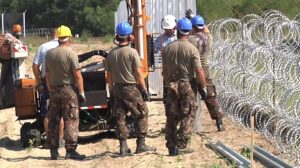
It was the newest chapter of a very old war. And then he did something the rest of Europe thought no member state would ever dare to do. All summer, crews had been racing along the Serbian border. On September 15th, 2015, they finished. The fence ran 175 kilometers. A low coil of razor wire stood in front of a steel mesh barrier about four meters high, later fitted with cameras, heat sensors, and loudspeakers that warned in several languages. Overnight, crossing it became a crime. Soldiers moved south and police reinforcements followed. When the flow simply swung west toward Croatia, Hungary started a second fence along that border too. Every door was closing at once. Behind the wire, the government hardened everything. It recruited thousands of new border officers. It gave the army new powers along the frontier and it set up fast track courts for people caught cutting through.
Anyone caught inside the country illegally was escorted back to the gate in the fence and put on the Serbian side. There were no hotels, no housing and no years of appeals. At the crossing near Rosca, crowds tried to force their way through and were met with tear gas and water cannon. The footage was everywhere. In much of Western Europe, Hungary became a symbol of cruelty, but in Central Europe and among a growing number of voters further west, it became something else. It was proof that a government that actually wanted to control its border could do it because here is the result. In September and October, daily arrivals had regularly passed 7,000. By November and December with the fences complete, the average had fallen to around 10 people a day. 10. The largest migration corridor in modern European history had been switched off, from Hungary’s side at least.
It looks like the end of the story. A small nation stood up, built a wall, the numbers collapsed and it was proved right, but it wasn’t the end. The flow had only been pushed elsewhere. And a few weeks later in the cities of Western Europe, the other half of the wager started coming due. November 13th, 2015, Paris. Gunmen and suicide bombers attacked the Bataclan Concert Hall, cafes and restaurants and the national stadium. 130 people were killed. It was the deadliest attack on French soil since the Second World War. Investigators later found that some of the attackers had moved into Europe hidden among the migrant flow along the Balkan route, the same route that ran through Hungary. Seven weeks later came New Year’s Eve in Cologne. Crowds of men gathered around the cathedral and the main station and women were surrounded, groped, robbed, and assaulted. Police received more than a thousand criminal complaints, hundreds of them sexual.
Hungary has not suffered a major Islamist terror attack in that whole decade.
For days, the authorities and much of the press struggled even to say who the attackers were. It kept coming. In March 2016, bombs went off at Brussels Airport and in the Metro. In July 2016, a truck drove through crowds celebrating Bastille Day in Nice and killed 86 people. In December 2016, a truck plowed into a Christmas market in Berlin, a few miles from the station where crowds had applauded the trains a year earlier. Christmas markets across Europe started ringing themselves with concrete barriers. That became the new normal in country after country. Hungary has not suffered a major Islamist terror attack in that whole decade. To this day, Budapest’s Christmas markets run without the concrete blocks that now surrounds so many others in Europe. Hungary’s foreign minister was asked in a television interview why his government talked about preserving a Christian Hungary. The interviewer seemed almost offended by the phrase.
His answer was simple. Hungary has been a Christian country for a thousand years, he said, and he didn’t understand why it was supposed to be bad news that Hungarians didn’t want to change that. Other countries could choose multiculturalism and Hungary didn’t judge them for it, but Hungary should be allowed to choose for itself. The interviewer pushed back that Hungary didn’t even have a migration problem. It had only a few thousand asylum seekers in a country of 10 million. That was the point. Hungary didn’t have the problem because it had refused to let the problem in. Orban wanted more than a fence. He wanted a verdict. In October 2016, he put the question directly to the people, “Did Hungarians want the European Union to be able to resettle non-Hungarians in Hungary without the consent of their parliament?” In effect, it was a vote on who decides who enters Hungary, Hungarians or Brussels?
The answer was crushing. More than 3.3 million people voted no to the quotas. Around 55,000 voted yes. That’s roughly 98% against, but there was a catch. Turnout fell short of the 50% the law required, so by the letter of the rules, the result wasn’t binding. The EU said the referendum had failed. Orban didn’t care. He pointed out that more Hungarians had voted against the quotas than had voted for his own party at the previous election. He called it a mandate and he acted like it. From then on, the fence was no longer an emergency measure. It was permanent national policy. The quarrel with Brussels was no longer about one chaotic summer. It had become a fight over who governs Europe, its nations or its institutions, and Hungary was about to raise the stakes. In June 2018, Hungary’s parliament passed a package of laws the government named Stop Soros after the billionaire financier Orban accused of bankrolling the pro-migration movement across Europe.
Under the new law, organizing help for people who had entered illegally to claim asylum became a criminal offense, punishable by up to a year in prison. That reached NGOs and activists, the whole network that helped migrants work the system. The law also closed the door on asylum itself. Anyone who had passed through a safe country on the way in could be turned down. Since nearly everyone arrived over land through Serbia, asylum on Hungarian soil became almost impossible. Along the border stood the transit zones, rows of fence containers where applicants waited for their cases to be decided. They couldn’t enter Hungary. They were free to leave only one way – back into Serbia. Budapest called it border management. Human rights groups called it detention, and slowly the machinery of European law turned against Hungary. In November 2021, the Court of Justice of the European Union ruled that the Stop Soros law broke EU law.
By then, the court had already found the transit zones and the pushbacks unlawful as well. On paper, Hungary had lost everything. Its signature policies had been declared illegal by the highest court on the continent. On the ground, almost nothing changed. The fence was still standing and the route was still dead. And by then, something extraordinary was happening across the rest of Europe. The countries that had condemned Hungary in 2015 were starting to build fences of their own. Greece reinforced and extended its barrier along the Everos River on the Turkish border. When Belarus began pushing migrants toward the European Union in 2021, Poland built a steel wall more than five meters high through the forest on its eastern border. Lithuania and Latvia did the same. The measures that had made Hungary an outcast were quietly copied one government at a time by the same governments that had shouted loudest against it, but Hungary itself wasn’t finished.
After the COVID lockdowns lifted, pressure on the southern border came roaring back. Attempted crossings climbed back into the hundreds of thousands. This time it was different. The route was controlled by smuggling gangs and they had stopped being cautious. Border police reported rocks hurled at patrol cars and crews trying to batter their vehicles. On the Serbian side of the fence, rival smuggling gangs fought gun battles in the border towns until Serbia itself sent in special police to clear the camps. So the fence was reinforced. Drones, thermal cameras, and constant patrols covered the border. And Serbia, which isn’t even an EU member, cooperated with Hungary and took people back. Britain gives you the contrast. When a small boat crosses the English channel, it’s met by the British authorities and the passengers are brought ashore in Britain where they’re housed, often in hotels while their claims are processed, sometimes for years.
Britain has paid France hundreds of millions of pounds to stop the boats and the boats keep coming. The cost of that is striking. Hungary has put its spending on the southern border at somewhere under two billion euros over roughly a decade, building, reinforcing and patrolling it. Britain, at the peak of its hotel bill, was spending around eight million pounds a day just to house asylum seekers. Even after that came down, it was still running at nearly six million pounds every single day. So one country spent about two billion over 10 years to keep the problem out and the other was spending around two billion pounds a year just to house it. And still, Brussels wasn’t done with Hungary. We’re about to get to the moment Europe tried to make Hungary pay literally for its fence and to Hungary’s answer, which no one in Brussels saw coming.
Hungary had stopped more than a million illegal migrants … Europe, you’re welcome
In June 2024, the Court of Justice of the European Union went further than it ever had against a member state over migration. Hungary, the judges said, still hadn’t complied with the earlier rulings, so they fined it 200 million euros upfront plus one million euros for every day it kept refusing. That’s a million euros a day for defending its own border. Think about what that actually means. A country is being fined by its own union for stopping illegal crossings into that union. In the European Parliament, a Hungarian member stood up and made Hungary’s case in a few blunt sentences. Hungary had stopped more than a million illegal migrants, he said. Europe, you’re welcome. And instead of a thank you, Hungary got a fine. He finished with a promise.
Hungary would not give in, it would not pay, and it would defend its borders, its women and its identity. The government didn’t pay. So in late 2024, the European Commission started deducting the money directly from the EU funds owed to Hungary. Brussels simply took it. A million euros a day sounds enormous. Set it next to Britain though, which was spending nearly six times that every day on hotels alone. That raises an awkward question Brussels has never wanted to answer. Which country is actually paying more for its choice? On the streets, the difference was hard to miss. Since 2010, Hungary’s registered crime has fallen by more than half from roughly 447,000 offenses to under 200,000. Budapest consistently ranks among the safer capitals in Europe. Jewish leaders have called Hungary one of the safest countries in Europe for Jews at a time when Jewish communities in Western Europe are being told to hide their kippahs.
Visitors notice it within an hour of arriving. The streets are full of families. There’s no tension around the train stations and no armed soldiers guarding the cathedrals. But here’s the part the critics almost never mentioned. Hungary isn’t closed to everyone. It took in tens of thousands of Ukrainian refugees after Russia’s invasion in 2022, people fleeing a real war right across its border from a neighboring Christian country with a culture Hungarians understand. The number of legal foreign residents roughly doubled over the decade, most of them workers on fixed contracts. So Hungary was never against everyone. It decided for itself who comes, how many, on what terms and for how long. And that idea, the one Europe spent 10 years calling extremist was about to go mainstream. Watch what happened across Europe in the years that followed. Germany, the country of Wir schaffen das, brought back controls on all its land borders in 2024.
A decade after the applause at Munich Station, German police were turning people away at the frontier. Sweden, which once called itself a humanitarian superpower, completely reversed course. A center right government came to power promising to cut asylum and applications fell to their lowest level in decades. Sweden now pays migrants to go home. Denmark, under a center-left government, adopted one of the toughest asylum regimes in the Western world and openly aimed for close to zero asylum seekers. Then Britain’s own labor government began modeling its asylum reforms on Denmark’s. Italy began processing migrants in Albania. In 2024, the European Union itself adopted a new migration pact built around faster border procedures and quicker returns. Under its solidarity rules, a country could refuse to take in migrants, but it had to pay instead. Hungary refused that too. 10 years earlier, these positions were outside the mainstream. Saying them out loud could end a political career.
Now they were government policy in Berlin, Stockholm, Copenhagen, Rome, and London. The country Europe had made an outcast had become, without anyone admitting it, the continent’s template. And then just when it seemed Hungary had won the argument, it lost the election. April 2026, Viktor Orban had ruled Hungary for 16 years straight, winning four landslides in a row. This time, he faced a man named Peter Magyar and his new party, Tisza. The results were a political earthquake. With nearly all votes counted, Tisza had about 53% of the vote and 138 of the 199 seats in parliament, a two-thirds super majority. Orban’s fetus was left with 55 seats. Brussels was euphoric. The newspapers wrote that European nationalism had been defeated and the populist era was over. Trump’s closest ally in Europe had finally fallen. That’s the second ending to this story, and it looks final. The fence builder is gone, Brussels has won, and Hungary is coming home, except Brussels didn’t look closely at who had actually won.
Peter Magyar is a 45-year-old lawyer who came up inside Orban’s own political machine. He was a fetus insider. He broke with Orban over corruption and a personal scandal, not over immigration. He spent two years going village to village and talking to voters face-to-face. And on immigration, he didn’t run to Orban’s left. He ran to his right. He attacked Orban for letting in too many foreign guest workers in recent years to plug Hungary’s labor gaps. He promised to cut that pipeline back. He said Ukraine couldn’t be fast-tracked into the European Union. He said he demands stronger guarantees for the ethnic Hungarians living inside Ukraine before backing Kyiv at all, and there was no talk of taking down the fence. Then look at what happened to Hungary’s left. The socialists who had governed the country twice before Orban were gone from parliament. So were the Greens and the Liberals.
The last real torchbearer of progressive politics in Hungary got barely 1.5% of the vote. So after 16 years, the only opposition that could beat Viktor Orban was one that agreed with him on the border. Orban lost the election, but his position on immigration won it. The new prime minister will make his deals with Brussels and unlock the frozen EU money Hungary’s economy badly needs. But on the question that started all of this, who gets to come into Hungary, the answer hasn’t changed. The fence is still standing. There is a harder truth underneath all of this. Hungary is a shrinking country. Its population is aging and falling and its labor shortages are real. Every economist in Brussels will tell you the obvious cure is immigration. Hungary looked at that cure and said no out loud. Instead, it bet on its own families. It offered generous tax breaks for mothers, loans that were forgiven as children arrived, and housing support for young couples.
The message was that Hungary would rather grow its own future than import one. It deliberately chose identity over economics and continuity over expansion, and it did so with its eyes open about the cost. Whether that bet pays off will take a generation to know, but it was Hungary’s bet to make. Go back to where we started, 7,000 people a day and then 10. At the beginning of this story, 10 looked like a statistic. It’s more than that. It measures how far a small nation was willing to go when everyone around it said the tide couldn’t be stopped. It measures what’s possible when a government decides its first duty is to its own people. Europe told Hungary that 10 was impossible, then it called 10 illegal, and then it fined Hungary a million euros a day for keeping it there. And 10 years later, half of Europe is trying to get its own number down.
Today, the fence runs quietly along the southern border. It’s patrolled and rarely tested. The trains at Keleti (railway station) run on time, the crowds are gone, and the crisis that once filled every television screen has faded into memory. But the question it raised hasn’t faded at all. Does a nation have the right to decide who enters it even against the will of the union it belongs to? Is that the betrayal of European values Brussels says it is, or is it the last line of defense of what Europe actually was? A small country with a thousand year memory looked at the largest migration in modern European history and decided that survival meant saying no. Brussels called that reckless. 10 years on, more and more of Europe is quietly doing the same thing. And if Hungary proves anything, it’s this. It’s never too late for a nation to decide what it wants to be, not while its people still remember who they are.
So where should the line be drawn? In Brussels or at a nation’s own border?
Readers will no doubt recognise Viktor Orban’s decision to close the border as an echo of Australian PM John Howard’s famous 2001 election statement which included: “we will decide who comes to this country and the circumstances in which they come.”