
Andrew L. Urban.
The anthropogenic global warming scenario was launched on June 23, 1988 in the US Senate committee with the testimony of James Hansen of NASA. In the Senate, a political not a scientific setting. It’s well to remember this as the Minister for Climate Change – a politician, not a credible climate scientist – reaches for the oppressor’s tool to clamp down as the overwhelming dissention about his policies continues to grow.
The scenario was born in dishonesty and has been characterised by it ever since. To emphasise the ‘warming’ at the congressional session, Hansen’s Democrat ally, Senator Tim Wirth, scheduled the hearing on a day forecast to be the hottest in Washington that summer. In addition, Wirth sabotaged the air-conditioning the previous night, hoping to ensure the TV cameras could show everyone sweating in the heat. Wirth later told Deborah Amos (NPR News) how he did it: “What we did is that we went in the night before and opened all the windows, I will admit, right, so that the air conditioning wasn’t working inside the room. And so when the hearing occurred … it was really hot…”
It is the Climate Change and Energy Minister and his gang of climate alarmists who peddle misinformation, in the spirit of Senator Tim Wirth sabotaging the air conditioning. It is a telling willingness to ‘misinform’ to fit the ideology. Wirth ‘misinformed’ the room … To turbocharge this mischief, Bowen now wants to suppress any public talk that questions his ruling orthodoxy. The communists do this at every chance to force citizens to follow the party line.
Let me show why Bowen is wrong not only morally but scientifically. I did a lot of research for my book Climate Alarm Reality Check (Wilkinson Publishing) and I include the chapter “What the scientists say”. Here are some excerpts:
* Writing in June 2022 on clintel.org, petrophysicist Andy May reported as follows: “Recently, the Biden administration has tried to use the powers of the SEC to force companies to disclose information on their supposed climate-related business risks through a proposed SEC rule. Two esteemed members of the CO2 Coalition, Princeton Professor, emeritus, William Happer and MIT Professor, emeritus, Richard Lindzen have reviewed the proposed rule and filed a critical comment on the rule with the SEC. In addition, they have filed an amicus curiae court brief with the U.S. Court of Appeals for the Fifth Circuit stating that they do not believe there is a climate-related risk related to burning fossil fuels, and the resulting CO2 and other greenhouse gas emissions.
The proposed SEC rule does not establish that there is a climate risk, they simply assume there is, based upon President Biden’s Executive Order 13990 and the various IPCC Reports. The amicus curiae brief deals with the executive order and its underlying technical support document’s (TDS) social cost of carbon (SCC) calculations.
Happer, who has studied possible CO2 related climate change for over 40 years, succinctly states his opinion:
”There isn’t a climate crisis. There will not be a climate crisis. It is utter nonsense.”
Lindzen has studied climate even longer than Happer, his comment:
“What historians will definitely wonder about in future centuries is how deeply flawed logic, obscured by shrewd and unrelenting propaganda, actually enabled a coalition of powerful special interests to convince nearly everyone in the world that carbon dioxide from human industry was a dangerous, planet-destroying toxin.
“It will be remembered as the greatest mass delusion in the history of the world – that carbon dioxide, the life of plants, was considered for a time to be a deadly poison.” (emphasis added)
Happer and Lindzen point out that these proposed reporting requirements will cost U.S. businesses more than $6.4 billion and might interfere with their ability to raise the capital they need to expand production of oil, gas, and coal. This latter problem is expressly opposite of the SEC mandate from Congress. The rules will increase the cost of fossil fuels, provide no benefits, and expressly harm the poor, who pay a larger percentage of their income for fuel. Happer and Lindzen believe there are no climate risks related to burning fossil fuels; thus, estimating and reporting these imaginary costs will unnecessarily and unfairly restrict the companies’ ability to borrow money because the additional risk reduces their value.
The SEC assumption is made because many prominent climate scientists share an opinion (the so-called “consensus”) that humans are affecting the world’s climate by burning fossil fuels and emitting large amounts of CO2. They also share an opinion that this is a bad thing. However, in the scientific world, the opinions of scientists and politicians are not relevant. This is not to say that anthropogenic climate change or the possibility of an anthropogenic climate change disaster are disproven, it is just to say that no valid evidence exists to support these hypotheses.
Neither Happer nor Lindzen believe the SEC and TDS arguments are scientifically valid. They state that reliable scientific theories make predictions that are later validated by observations. They are not from a scientific consensus, government opinion, peer review, or manipulated data. In the words of Professor Richard Feynman, as quoted by Happer and Lindzen:
“[W]e compare the result of [a theory’s] computation to nature, … compare it directly with observations, to see if it works. If it disagrees with the experiment, it is wrong. In that simple statement is the key to science.” Richard Feynman, The Character of Physical Law (1965), p. 150.
Models have been created to show the hypothetical human-caused changes to climate and the supposed damage these changes might cause. Unfortunately, or fortunately, perhaps, the models do not compare well to observations. Using Feynman’s rule, this invalidates the catastrophic climate change hypothesis. See here for more on the model/observations mismatch.
While the SEC can make rules mandating disclosure of valid risks to a business, it should not mandate disclosure of imagined risks that are not scientifically established.
* The aforementioned Lindzen has made the following point: “I suspect that many people believe that there is an instrument that measures the Earth’s temperature. As most of you know, that is not how the record was obtained.
“Obviously, the concept of an average surface temperature is meaningless. One can’t very well average the Dead Sea with Mt. Everest. Instead, one takes 30 year annual or seasonal means at each station and averages the deviations from these averages. The results are referred to as annual or seasonal mean anomalies.
“…we are bombarded with claims that the impacts of this climate change include such things as obesity and the Syrian civil war. The claims of impacts are then circularly claimed to be overwhelming evidence of dangerous climate change. It doesn’t matter that most of these claims are wrong and/or irrelevant. It doesn’t matter that none of these claims can be related to CO2 except via model projections. In almost all cases, even the model projections are non-existent. Somehow, the sheer volume of misinformation seems to overwhelm us.” (Emphasis added.)
Readers may recognise the official line from Bowen’s department as “sheer misinformation” too. Or not: there is a theory that the climate policies are deliberately destructive of free market economics.
* In Mark Steyn’s A Disgrace to the Profession (Stockade Books, 2015), a comprehensive debunking of the consensus and in particular targeting Michael Mann’s infamously influential but since discredited hockey stick graph, there are 100 scientists quoted who, far from supporting any consensus on global warming, raise their dissenting arguments and their concerns about misleading information.
“Some of them,” Steyn explains, “are distinguished emeritus profs and Fellows of the Royal Society, but some are young up-and-comers. Many are from the heart of the Anglo-American climate establishment, but others are from Europe and elsewhere and don’t quite understand why a small clique of outliers singlehandedly determines the “consensus” in the field …”
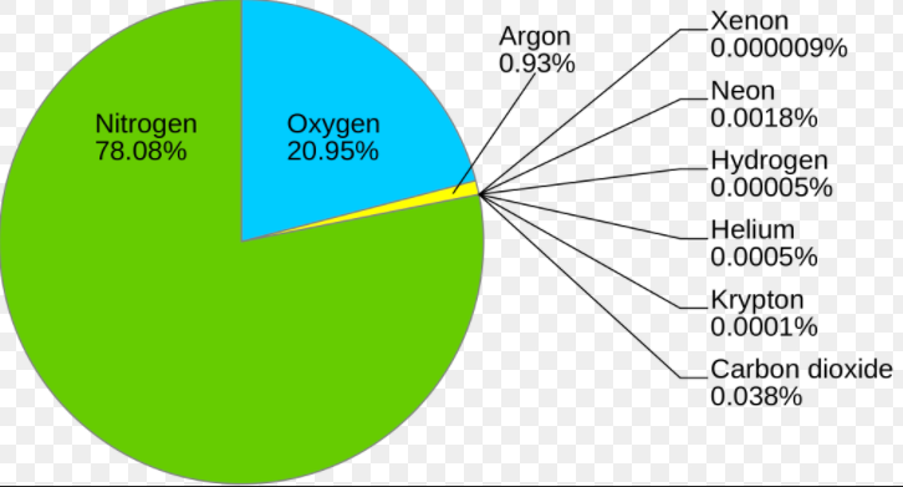
composition of atmosphere
* People tend to avoid information that is inconsistent with their beliefs. If they cannot avoid new information that challenges their beliefs, they tend to evaluate it in ways that leave their prior beliefs unchanged. If they have no prior beliefs, they tend to adopt the beliefs of their friends, authorities, or groups with whom they identify. Experimental studies have shown that groups typically reject people with opinions that differ from the beliefs of people in the group. That happens even for newly formed groups when asked to decide on something about which they had no prior opinion. Pressure is directed against deviants, who face ostracism if they do not quickly agree with the group. (eg ‘climate deniers’…also referenced in the section on ‘Skepticism’)
* The authors of The Scientific Method. J. Scott Armstrong and Kesten Green had already published a paper (Green, Kesten C. and Armstrong, J. Scott, The Global Warming Alarm: Forecasts from the Structured Analogies Method (March 31, 2011.[1] which reveals the depth of betrayal of climate science. They write:
“ … we searched the literature and asked experts to identify phenomena that were similar to the alarm currently being raised over dangerous manmade global warming. We obtained 71 proposed analogies. Of these, 26 met our criteria that the alarm be: (1) based on forecasts of human catastrophe arising from effects of human activity on the physical environment, (2) endorsed by experts, politicians and the media, and (3) that were accompanied by calls for strong action. None of the 26 alarms were based on scientific forecasting procedures. None of the alarming forecasts were accurate.”
* Confirmation bias is the tendency to interpret new evidence to support one’s existing beliefs. It also involves efforts to seek confirming evidence and to avoid challenging information. If a challenge cannot be avoided, the source of the challenging information is dismissed as untrustworthy (emphasis added); Minister Bowen, please note.