
Andrew L. Urban.
In the wake of the Nobel Peace Prize award to the antisemitic South African jurist Navi Pillay, it might calm you down a bit (as it did me) to know that unlike the committees that award the other Nobel prizes, drawn from Sweden’s learned institutions, the peace prize committee is appointed on a party-political basis by the Norwegian parliament. Politics is not incidental to the process; it is encrusted in its nature. That explains its novel nature but doesn’t excuse it.
The committee that awarded Pillay the prize is chaired by Jørgen Watne Frydnes, the Labour appointee whose term ends in December. A longstanding critic of Israel, which he (stupidly) considers an “apartheid state”, Frydnes called the accidental killing in Gaza of Al Jazeera “journalists” who moonlighted as terrorists, a “grotesque attack on the freedom of expression”. Crowning his chairmanship by canonising Pillay can only enhance Frydnes’ adulation by Norway’s vehemently anti-Israel left.
I am grateful to Henry Ergas whose column in The Australian (Oct. 16, 2026) included this information. He went on to say that “The underlying issue, however, is neither Frydnes nor Pillay. Both are symptoms of a broader disease: the chronic abuse of the term “genocide”. It’s everywhere …
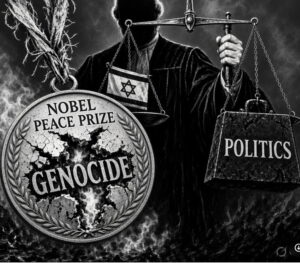
Having assured the world that “a Muslim cannot perpetrate a genocide”, Recep Tayyip Erdogan now accuses Israel at every opportunity of committing one. The history of his own country is absolved by assertion; Israel is condemned by incantation. For him, as for Pillay, the mere fact of Palestinian casualties tars Israel with the “crime of crimes”.
As the accusations multiplied, the word’s meaning dissolved. By 2015, some 80 countries, home to four-fifths of humanity, had been accused of “genocide”, with the term’s infinite varieties covering everything from the extinction of languages to the disappearance of often barbaric cultures. “Genocide” had become “a hollowed-up vessel that could be filled with any meaning”.
Yet drained of precision, the word retained its power, which fed on the memory of the greatest slaughter of Jews in history: the more sacred that memory became, the more potent its appropriation. Turned against Israel, the accusation consummated an outrageous inversion: the murdered Jews supplied the moral authority for demonising the Jewish state. And what more damning charge could there be than to charge the people marked for annihilation of perpetrating the same crime against others?
But the dead cannot be conscripted into that monstrous travesty without falsifying how they died. Nor can the parallel be sustained without suppressing how this war began and whom Israel was fighting.
That beginning was the massacre of October 7. As for the enemy Israel confronted, it was heavily armed, had vowed to repeat the atrocities “again and again”, and did nothing to protect, and everything to deliberately imperil, Gaza’s civilians from the wars it had chosen to unleash.
Perhaps the most telling sign of the moral fraud committed by those accusing Israel of genocide is their refusal to confront the rational arguments against that charge. That refusal is surely fused to the innate antisemitism of those accusers. As the late Peter Hitchens maintained, that which is asserted without evidence may be dismissed without evidence. So it is thus dismissed.