
Andrew L. Urban.
“When the High Court takes a step in the wrong direction, the full impact might not be immediately apparent. But consequences eventually pile up until reform becomes inevitable. That day has finally arrived for one of the court’s worst ideas: 1992’s implied constitutional freedom of political communication.” That’s the opinion of Chris Merritt, Vice President of the Rule of Law Institute of Australia. And with good reason.
Following the Bondi terrorist attack in December 2025, the NSW Government passed emergency legislation empowering police to prevent authorised public assemblies in designated areas after a declared terrorist incident. The restrictions were used across Greater Sydney and remained in force, with amendments to their geographical scope, until February 2026.
Joshua Lees of the (Nazi-themed antisemitic) Palestine Action Group (PAG), Elizabeth Jarrett of the Blak Caucus and Michelle Berkon of Jews Against the Occupation ’48 challenged the legislation. On 16 April 2026, the NSW Court of Appeal held the challenged provisions invalid because they impermissibly burdened the implied freedom of political communication. The Court rejected the proposition that the government’s broad restrictions were constitutionally justified by the stated objectives of protecting the community and promoting social cohesion.
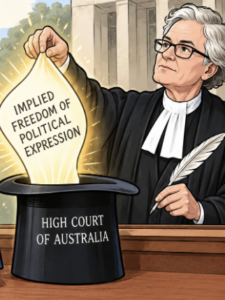 This doctrine (of an implied freedom of political expression), writes Merritt, “appears nowhere in the written text of the Constitution. It is a judicial creation that changed the balance between parliament and the courts in a way that was never approved by the Australian people. The implied freedom, therefore, lacks democratic legitimacy. It is also a confused mess.” Surely not, not the High Court!
But yes, it is. “There has been quite a number of terrible decisions of the High Court since its establishment in 1901 at Federation. But the 1992 judgment that discovered – the word is used advisedly – the implied freedom of political communication in the Constitution has a good claim to be the worst of all,” writes Michel Sexton, NSW Solicitor General, echoing Merritt. “Over the past three decades since this initial decision, the court has developed elaborate formulas to assess an ever-increasing number of challenges to federal and state legislation based on a claim of a contravention by the legislation of the implied freedom.”
But the PAG doesn’t always win. The planned protest against Israeli President Isaac Herzog’s visit in February 2026, the challenge to expanded police powers failed. During Herzog’s visit to Sydney, the government invoked major-event legislation to give police expanded powers. The PAG challenged the declaration, arguing in part that it was being used to prevent protests against the Israeli President. On 9 February 2026, the challenge was dismissed.
Then there was the PAG’s proposed (pretentiously named) “March for Humanity” across the Sydney Harbour Bridge on 3 August 2025. It directly illustrates the constitutional tension between a Premier’s pragmatic opposition to a demonstration and the legal authority to prevent it. Premier Chris Minns publicly opposed the march. He argued that closing a major transport artery, even temporarily, would cause unacceptable disruption to Sydney. Police also raised public-safety concerns and sought to prevent the march from proceeding in its proposed form.
The organisers had notified police of their intention to hold the procession, which was intended to draw international attention to the humanitarian situation in Gaza. Rather than simply accepting the Premier’s opposition as sufficient grounds to stop it, police sought a prohibition order from the NSW Supreme Court. On 2 August 2025, Justice Belinda Rigg* refused the police application. She concluded that the Commissioner had not established sufficient grounds to withdraw the legal protections afforded to an authorised public assembly. The march proceeded the following day.
* In his column in The Australian, “Judge doesn’t deserve criticism for decision to allow Sydney Harbour Bridge protest march” Chris Merritt points out that “What happened on the bridge is not the result of judicial activism or bias. It is the result of a flawed permit system for street protests that smoothed the way for a great national icon to be used for propaganda purposes.
It is also curious that there is no sign in Rigg’s judgment that anyone bothered to tell the judge about legal changes in 2022 that protect major facilities.
That new law, Part 4AF of the Crimes Act, imposes criminal penalties on protesters who block access to major facilities.
Part 4AF was inserted into the Crimes Act by an amendment that also changed the Roads Act, which now imposes criminal penalties under section 144G for obstructing major bridges – including the Harbour Bridge.
The judge might have appreciated it if someone had mentioned Roads Act regulation 48 which says: “A person must not, on the Harbour Bridge … conduct or participate in any public assembly or procession.”
Frankly, I’m not surprised. I observed Belinda Rigg SC in June 2020 in action when she was Senior Public Defender acting for Robert Xie at his appeal against the (wrongful, as I argue in my book FRAMED – how the legal system framed Robert Xie for the Lin family murders) murder convictions of five of his wife’s family. It was a train wreck; the appeal was dismissed. Not only did Rigg ignore her client’s well-informed instructions, she made serious errors of judgement in front of the three judges on the bench. Not that they distinguished themselves, either.
Chris Merritt – VP of the Rule of Law Institute:
https://www.theaustralian.com.au/business/legal-affairs/helping-white-supremacists-nazis-and-jew-baiters-not-high-courts-aim-when-it-created-implied-freedom-of-political-communication/news-story/85302b5c42d3684650de979a90afc590
When the High Court takes a step in the wrong direction, the full impact might not be immediately apparent. But consequences eventually pile up until reform becomes inevitable.
That day has finally arrived for one of the court’s worst ideas: 1992’s implied constitutional freedom of political communication.
This doctrine appears nowhere in the written text of the Constitution. It is a judicial creation that changed the balance between parliament and the courts in a way that was never approved by the Australian people.
The implied freedom, therefore, lacks democratic legitimacy. It is also a confused mess.
Michael Sexton – NSW Solicitor General:
https://www.theaustralian.com.au/commentary/high-court-implied-freedom-of-political-communication-ruling-damages-democracy/news-story/b85b5706033325f720c0fed924452a1c
There has been quite a number of terrible decisions of the High Court since its establishment in 1901 at Federation. But the 1992 judgment that discovered – the word is used advisedly – the implied freedom of political communication in the Constitution has a good claim to be the worst of all.
Over the past three decades since this initial decision, the court has developed elaborate formulas to assess an ever-increasing number of challenges to federal and state legislation based on a claim of a contravention by the legislation of the implied freedom. Despite the legal verbiage of these formulas, however, the end point of their analysis is the subjective opinion of whether the legislation is reasonable in the eyes of the members of the court.