
Andrew L. Urban.
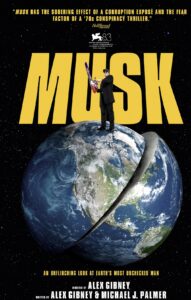
‘An unflinching look at Earth’s most unchecked man’ is the promo tag on the poster for Alex Gibney’s latest documentary”, MUSK, a 3hr 45m Muskbuster, coming to (some) Australian cinemas in February 2027. Seeing the trailer, I got the distinct impression that the acclaimed documentarian of films such as the Oscar winning Taxi to the Dark Side (2008) and Oscar nominated Enron: the Smartest Guys in the Room (2006 ), Alex Gibney had an agenda from the start. So I sought out some professional and authoritative critics (familiar from my previous life as a film critic). Below are extracts from reviews by two of the best known sites, followed by some of my comments.
Peter Bradshaw, The Guardian:
“Elon is a nuke.” The speaker is Ashley St Clair, a former conservative Maga influencer and one of Elon Musk’s former girlfriends-slash-baby mommas.
“She is a fascinating expert witness in Alex Gibney’s four-hour epic study of the world’s richest and dullest man: the overgrown brattish South-African-born trillionaire plutocrat, ersatz visionary and Trump courtier who owns Tesla cars, SpaceX rocket ships, Starlink satellites on which nation states’ military capabilities are increasingly reliant, X (formerly Twitter) which shapes the collective incel id of billions and GrokAI whose vast server farms daily guzzle oceans of precious water.
“He does indeed look like a nuke, efficiently designed, destructive, seemingly unguided and uncontrolled.
“Gibney’s excellent film covers a lot of ground in its extraordinary story, although we don’t get to hear about the mysterious process that changed a balding youngster into a follicularly unchallenged mature man.
“Musk is a uniquely disquieting baseball-capped figure, grinning and giggling and smirking on a thousand sycophantic podcasts … Gibney doesn’t get to talk to Musk (or Trump) though in the spirit of Musk’s AI interests, he creates a photorealistic CG avatar who mouths all the things the man himself is reported as saying (a rather contrived visual joke, actually, which the film didn’t need).
“His SpaceX adventure and his preposterous and ignorant effusions about colonising Mars were spectacular advertisements for his personal brand – so important for inflating stock market valuation – especially when he did indeed invent rockets that could be landed and re-used. But the question of how and when these rockets will carry us to inhabitable planets remains unanswered.”
Nell Minow, Roger Ebert.com:
“Oscar-winner Alex Gibney’s 4-hour documentary about Elon Musk may be the most important film of the year. After the first two hours, audiences will learn that he is better at engineering everything around him to suit his ego and his bank account than he is at engineering his many products. We see the damage he has inflicted, including horrific dash-cam footage of fatal accidents involving self-driving cars.
“Probably the film’s most controversial choice is Gibney’s use of a digital avatar for the title character. Musk declined to be interviewed, so Gibney created an AI image to “speak” words from Musk’s actual statements and interviews. Perhaps intentionally, the avatar is on the edge of the uncanny valley, the head a bit large, the movements a bit stiff, fitting for someone who speculates on the “very high probability” that we may all be in some sort of “Matrix”-like simulation of reality or that he could “bend the laws of reality.”
“We see harrowing footage of fatal accidents caused by Tesla self-driving cars, and even more harrowing comments from Tesla staff about faking the cars’ performance.
“We hear from Martin Eberhard, the founder and first CEO of Tesla. Musk became an investor and then took over. Eberhard tells us that it wasn’t enough for Musk to become CEO; he insisted on rewriting history to dub himself the founder. Similarly, we learn that Musk wanted to “look like an engineer.” He is not an engineer, but he is an effective shaper of his own reputation, bank account, and bio-dynasty (now at least 14 children with four mothers, many living on a compound he built).
“In the second half of the documentary, we see how extensively Musk has engineered his way into every aspect of American and almost every aspect of global affairs.
“Some may know it promised to save the government $2 trillion, but it claimed only $215 billion in savings, and independent external audits have challenged that number, finding that the DOGE cuts actually cost more than they saved.
“The devastating throughline that dominates every chapter of this story is Musk engineering whatever benefits his ego and his net worth, not just intertwined but essentially the same thing. Musk’s operations are also intertwined with just about every aspect of our lives.”
If the film applauds the value of freeing speech on Twitter or the benefits of Starlink to enable Ukraine to maintain communications (notably in hospitals, medical and emergency services) even when Russia has destroyed or disrupted conventional telecommunications infrastructure, these critics do not say. (In April 2022, USAID announced the delivery of 5,000 terminals to Ukraine through a partnership with SpaceX. Of these, 3,667 were donated by SpaceX and 1,508 purchased by USAID, according to a subsequent US government inspection report.)
Now, do not focus on the bias of the critics; instead, examine how their comments reflect the bias and agenda of the filmmaker. The reason I will resist seeing the film on its release is that almost 4 hours of relentless anti-Musking would become boring well before half time.
If I’ve just saved you several hours of your time and the ticket price, you are welcome. Mind you, there will be others who will rejoice at the “in your face” nature of the film, much to the distributor’s relief. I cannot say what effect the film will have on Gibney’s reputation as a documentarian.