
Andrew L. Urban.
Australian PM Anthony Albanese is famous for his favourite pastime, “fighting Tories, that’s what I do”. Like some head of a one party state, with Labor’s large Parliamentary majority, he is using Communist Party tactics to manipulate democracy to pursue his own ideological ends. Two current, unrelated but pertinent issues sound the alarm.
First, let me support the assertion in the headline, with reference to the practices of Communist regimes.
Stalin-era Article 58-10 made it a crime to engage in:
- Propaganda or agitation “with the purpose of undermining or weakening the Soviet power” (or committing/inciting especially dangerous state crimes).
- Disseminating “slanderous fabrications that target the Soviet political and social system.”
- Producing, disseminating, or even storing literature of similar content for those purposes.
Penalties typically ranged from six months to seven years’ imprisonment, often followed by internal exile of two to five years.
Why ‘vague’ is effective for repression
The language centered on protecting the Soviet state and system from “harm” or “undermining,” framed in national-security and public-order terms. In practice, authorities (especially the KGB) decided what counted as “slanderous,” “anti-Soviet,” or intended to weaken power. Truthful reporting of abuses, criticism of Party policy, samizdat (underground literature), human-rights monitoring, or even private conversations could be treated as criminal. There was no meaningful independent judiciary or free press to challenge the characterization.
This was one of the two main legal tools (alongside the related Article 190-1 on disseminating “patently false” information defaming the system) used against dissidents from the 1960s through the mid-1980s.
The Communist Party maintained a monopoly on defining the “public interest” and “security of the socialist state.” Any independent political speech, association, or information that challenged the official line could be recast as a threat requiring criminal punishment. Democratic freedoms of expression, press, assembly, and association were thereby criminalized under the banner of protecting the system from harm.
This pattern—broad, purpose-based language about state security or social harm applied selectively by a one-party state—was characteristic of how the Soviet legal system subordinated individual rights to Party control.
China’s Criminal Law Article 105 (subversion/inciting subversion of state power), the catch-all “picking quarrels and provoking trouble” offense (Article 293), the 2015 National Security Law, and the 2020 Hong Kong National Security Law function in ways closely analogous to the Soviet Union’s Article 70 and related provisions.
These laws use broad, purpose-based language cantered on protecting “national security,” the “socialist system,” “state power,” or “public order.” In practice, the Chinese Communist Party (CCP) and its security organs determine what constitutes a threat, allowing criminalization of peaceful criticism, association, online speech, human-rights advocacy, and democratic organizing.
As with the Soviet system, the CCP maintains a monopoly on interpreting what endangers the state or socialist system. Independent political speech, association, assembly, and information-sharing that challenge Party control can be reframed as criminal threats to national security or public order. Comrade Albanese appears to have copied this model for the Digital Duty of Care legislation.
1 – DIGITAL DUTY OF CARE v LIBERTY

The government’s plan to control what can be said online would set back the cause of liberty by centuries. At the heart of this bill are vague and open-ended terms that would turn the regulation of communications on its head, says Rule of Law Institute’s VP Chris Merritt.
It would empower the eSafety Commissioner and online service providers to prevent dissemination not just of unlawful information, such as support for terrorism, but of a vast category of information that breaches no law but is deemed by bureaucrats to be “seriously harmful”.
This bill bypasses the need for parliament to declare specific forms of speech unlawful and to demonstrate why suppression is necessary. Educational material on topics that are considered by the commissioner to be “seriously harmful” could only be disseminated if the commissioner also deems it to be “not contrary to the public interest”.
The commissioner would have the same veto over the dissemination of literary and artistic works.
Because there are no criteria in the bill on how that “public interest” assessment is to be applied, the future of online education about the arts, literature and everything else would depend on the commissioner’s unfettered discretion.
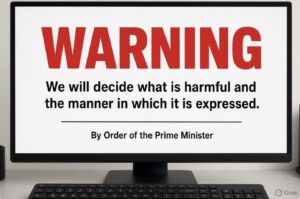
The fact that this provision exists shows this bill is intended to give the eSafety Commissioner the power to censor “seriously harmful” online education on an unlimited range of subjects based on her unfettered judgment of what is not in the public interest. It is hard to imagine any legitimate grounds for censoring educational material. It is not unreasonable to expect the Bill once passed to be expanded to include offline speech.
This bill is the most potent illustration of how the Albanese Labor government is attempting to acquire the tools of repressive authoritarian states such as the old Soviet Union or the current Chinese Communist Party, where crimes are created on the pretext of vague ‘national security’ and ‘harmful to the people’ grounds, for the purpose of controlling visible dissent or criticism.
2 – NO ALBO AT ROYAL COMMISSION
Former Australian Federal Police chief Mick Keelty said responsibility for preventing such terrorism ultimately lay at the feet of government and blasted policy makers for having “skilfully attempted to avoid scrutiny” by the royal commission. “I think it’s pretty arrogant. They’re either avoiding something that they know that they didn’t want the commission to identify, or they’re being arrogant and continuing their disregard for the royal commission and their dislike for the royal commission.”
But Home Affairs Minister Tony Burke declared he and his colleagues would have “immediately” co-operated if they had been hauled in. Ahead of the royal commission handing down its final report in five weeks, senior policing and intelligence figures lashed the absence of any government ministers in public hearings held over the past six months, warning that if frontbenchers could not “value add” to an investigation into Australia’s mostly deadly terrorist attack there was “something drastically wrong”.
Former Department of Home Affairs secretary Mike Pezzullo said he was “puzzled” why ministers and high-ranking heads of policing agencies weren’t called by Ms Bell.
An FOI request by The Australian last month proved Mr Albanese made no official representation to the commission – not even drafting preparatory material on the chance he was called. The Prime Minister pledged total noninterference through the course of the commission’s work (he actually meant no appearance), first resisting calls to voluntarily give evidence under cross-examination, then refusing to substantially extend its deadline when stakeholders became concerned with its quick turnaround. Albanese had no intention of giving evidence at the Royal Commission.
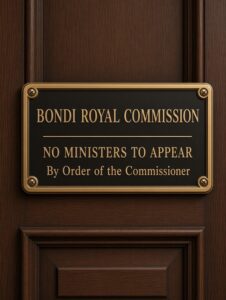
But it is Virginia Bell who has kept quiet on why her royal commission failed to call any government ministers to give evidence. Bell would not explain why she had not called on Labor frontbenchers to appear. Why not?
Under the circumstances, a cynic might conclude that perhaps at her appointment to the Commissioner’s role, Virginia Bell, had been directly or indirectly advised that government ministers were not to be called to appear. Of course, it may well be a self-imposed condition by the Commissioner… Either way, it raises profound questions the public has a right have answered.
Transparency and accountability have been ignored, replaced by ‘pretend freedom & safety’ in the manner of Communist regimes. So let’s remind comrade Albanese that there are plenty of people who “like fighting Commies, that’s what we do”.