
Andrew L. Urban.
Special envoy Jillian Segal is now calling for the fight against antisemitism to be taken up in local council rooms and on playing fields, urging mayors and sporting bodies to consider measures aimed at stamping out hate. As British writer, wit and actor Stephen Fry once said, ‘It is easy to forget that the most important aspect of comedy, after all, its great saving grace, is its ambiguity. You can simultaneously laugh at a situation and take it seriously’. In that spirit, I rise to ridicule antisemites.
Segal said slurs and coded references such as hissing sounds mimicking gas chambers, chants invoking Hitler or the Holocaust, and “jokes” that trade on antisemitic tropes were among the most common forms of antisemitic abuse in sport. It’s all pretty childish and unimaginative, as we’d expect it to be. After all, antisemites are not noted for their sense of humour, a sense I associate with intelligence and rational thought.
A particularly effective form of anti-antisemitic humour exposes the contradiction at the heart of the antisemitic conspiracy: the antisemite imagines Jews to be simultaneously weak and all-powerful, marginal and secretly controlling everything, inferior and terrifyingly superior.
Jokes ridiculing antisemitism demonstrate the poverty of its intellectual heft.
After the assassination of the Tsar, a Russian official confronted a rabbi.
“I suppose you know who was behind it?”
“I have no idea,” said the rabbi, “but the government will blame the Jews and the chimney-sweeps.”
“Why the chimney-sweeps?”
The rabbi replied:
“Why the Jews?”
More recently…
An antisemite tells a friend:
“Jews are weak, cowardly and inferior. Yet somehow they control the banks, the media, the governments and the world.”
His friend asks:
“Have you ever considered that your theory might be a little contradictory?”
The antisemite replies:
“That’s exactly what they want you to think.”
MAN A: I’m not antisemitic, I just believe Jews secretly control everything.
MAN B: Everything?
MAN A: Everything.
MAN B: Then why are you still unemployed?”
Ridiculing antisemites as buffoons may not convert them but it will tend to limit the manifestation of antisemitism. It may shrink the eagerness to display it publicly, which is a step in the right direction. The less there is of public demonisation of Jews, the less likely are the easily led to be influenced.
Jewish comedian Alex Edelman tells the real-life story of how he infiltrated a meeting of white nationalists in Queens, New York, after receiving antisemitic online abuse.
The comedy comes from the extraordinary contradictions and absurdities of the people he encounters: their conspiratorial worldview, their petty concerns, and their indignation when they are called Nazis. He admits to feeling sorry for white supremacists: “they are always unhappy”.
The show was acclaimed on Broadway and is described by reviewers as both hilarious and a serious examination of antisemitism. (refer Stephen Fry, above).
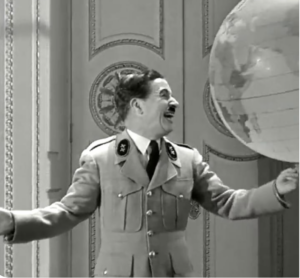
The Great Dictator
Before Alex Edelman and his fellow Jewish comedians, there were Dr Seuss’s political cartoons, which attacked Hitler, fascism and American isolationists who were reluctant to confront Nazism; Disney’s animated film Der Fuehrer’s Face, in which Donald Duck experiences the absurdity and oppression of life under a Nazi regime; Ernst Lubitsch’s To Be or Not to Be, which used theatrical farce to ridicule Nazi officials and their pretensions; and of course, Charlie Chaplin’s The Great Dictator. Chaplin played both the dictator Adenoid Hynkel, an unmistakable parody of Hitler, and a Jewish barber living under his regime.
The film ridiculed:
- Hitler’s megalomania and theatrical posturing
- Nazi claims of racial superiority
- The absurdity of a dictator imagining himself master of the world
- The cowardice and hypocrisy of authoritarian leaders
In the celebrated globe scene, Hynkel dances with an inflatable globe, treating the world as his personal toy. The globe eventually bursts. The joke is not that Jews are ridiculous. It is that the dictator’s grandiose ambitions are childish and delusional.
Chaplin made the film when Hitler was still in power, at considerable personal and professional risk. Nazi supporters protested its exhibition in several countries.
And 30 years after Chaplin, it was the turn of Mel Brooks; in The Producers, he took the ridicule of Nazism to an outrageous extreme. The plot involves two theatrical producers who deliberately stage a disastrous musical called Springtime for Hitler, expecting it to fail. Instead, its absurdly enthusiastic Nazi spectacle becomes a hit.
The humour depends on turning the supposed grandeur of Nazism into grotesque theatrical kitsch.
Somebody should make a movie ridiculing Hamas in the same light. The grotesque cos-play hiding the face with a keffiyeh, the index finger pointing skyward, the grandiose claim versus the actual conduct, the self-appointed liberators denying freedom to their own people … there is plenty of satire-ready material. Maybe an energetic musical, Free Palestine … Tomorrow, about an ageing Hamas soldier reminiscing how his grandfather and then his father had kept dismissing chances to create a Palestinian state but had always promised it “tomorrow” … Satirising the history of nine separate missed opportunities since the 1947 UN Partition Plan was rejected by the Arab Palestinian leadership, through the 1978 & 2000 Camp David summits to the 2008 and 2020 proposals. So cry me a river … or a sea.